The Manta, She is Here...
From the original Analog Industries archive. Some links and images from that era no longer resolve.
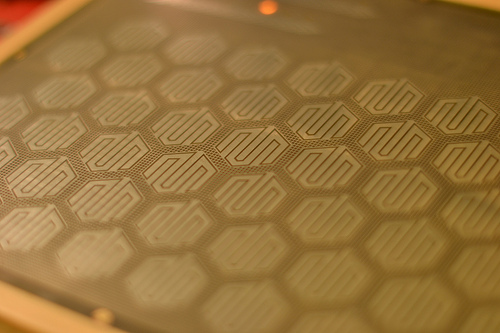
The Synderphonics Manta showed up last night. My initial impression is that it’s a really nice little instrument. It is functionally similar to the monome, inasmuch as it is (at its base level) a bunch of buttons and a bunch of LEDs. However, the thing that makes this a vast improvement over the monome is that it has several different levels of control in addition to the single on/off state of the monome. (The monome’s main attribute that sets it apart from the Manta is that it is far more tactile; you could theoretically play it without looking. Not so much with the Manta.)
Each hex sends a variable along with the touch, and basically, how much of your skin is in contact with the hex informs the amount of the variable. In this way, you get an initial velocity and a continuous control message. (For example, you can have the initial hit as note velocity, and then a finger rolling kind of gesture gives you, say, aftertouch.)
In addition, there are two control-value-only “sliders” and four buttons at the top which essentially act the same as the hexes except they don’t have the contact-area, and thus can’t have velocity or continuous control. They’re just on-off or momentary buttons. And finally, the whole unit has a “centroid” x/y/amount value that is a running average of how much flesh you have pressed against the unit, and where that flesh is centered.
Much like an EWI or similar instrument, you can just play a synth sound out of the box, or fire off some samples, but one really needs to develop a specific technique for this thing, I think. It is quite expressive once you get used to its quirks, and learn to take advantage of its strengths. One aspect of the essentially flat profile is that I’m able to play lightning fast on it. This obviously isn’t that useful in the kind of music I make, and it also is heavily dependent on how the notes are grouped, I think. But I believe that if you were to adopt this as your main controller, you could develop a fairly articulate style.
The OS X stand-alone software is not quite there; it is rather crashy, in the “I don’t want to use this on stage” way. The available Max patches work fine with the Max runtime, and that’s how I’m currently using it; I’m sorely tempted to build a VSTi for it or some such, because without M4L or Max, it is kind of hobbled. I’m given to understand there is a Pd external in the works, as well.
So, overall, my impression is that it is well worth the money, provided you either work in Max, or don’t mind using the Max runtime. If you plan on using it with the OS X standalone, plan again, and there is currently no Windows or Linux standalone. But for my own needs, two thumbs up.
(Full disclosure: I did not buy this unit. It is a loaner from Snyderphonics. I’ll see how I take to it, but I’m fairly certain I’m going to end up buying one at this point.)
Comments
Comments are closed on this post.