Algorithmism...
From the original Analog Industries archive. Some links and images from that era no longer resolve.
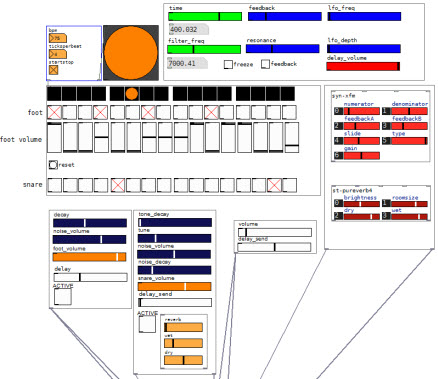
Longtime readers will note that I’ve often said that spring reverbs can’t be duplicated in software with existing technology. This subject came up in our most recent “What Should Audio Damage Make” thread. As a result of discussion that took place in that thread, Adam and Sean and I were having an e-mail go-round about spring reverbs. During the course of this, Adam pointed out to me that virtually anything can be expressed with a mathematical algorithm; the question is really whether we’re smart enough to come up with one.
Now, this didn’t change my opinion on spring reverbs in the slightest, and I’ve yet to hear an algorithmic spring worth a shit. But it did get me thinking about algorithms as they relate to music. I was pondering the fact that, given that I can synthesize a palette of sound broad enough to be the toolkit for a song using algorithms alone (where “palette” in this case can be used to mean both sounds and effects), and given that I’m able to sequence those sounds in to an interesting and meaningful pattern using more algorithms, one could take all this combined nonsense together, and theoretically create an algorithm that could, given a set of initial conditions, poop out an entire piece of music on its own that was fairly pleasant to listen to.
While this was an interesting hypothesis on my part (at least to me, anyhow) I thought that it could stand some experimentation. So I set out to create an entire Pd abstract where one could set a state, press “go,” and sit back and listen to a nice piece of music. I’ve been at it for several days now, and I’ve got a drum beat and a bassline occurring. So I’m a long, long way from proving my hypothesis.
But, for what it’s worth, I’m fairly certain it’s possible. Autechre did this quite a bit in Confield and a couple other releases, but it was mostly sample firing and MIDI output. My attempt is entirely procedural, pure code. No samples or MIDI at all; it will be completely synthesized on the fly in Pd, and all the effects done in real-time.
Anyhow, all personal windmills aside, the real point of this post is to propose the following: modern song-writing environments, mainly Live and to a certain extent Garageband and the various looperific tools in the top-line DAWs, have created a situation where the song itself is an instrument. When you grab a pile of loops and put them in the clip view of Live and put them in meaningful groups and what-not, you are not so much using Live as an instrument as you’re using fairly large chunks of sound as the instrument, and Live is merely a facilitator (in the same fashion that a guitar amp is the facilitator of the guitar.)
Of course, you can certainly synthesize and record within Live or whatever DAW. I’m referring strictly to the practice of creating songs from samples. Am I horribly misguided in this theory?
10 comments
Not misguided. You have in fact expressed what I've been thinking for many years but have expressed differently. People ask me what instrument I play, my answer is "the studio" meaning basically whatever sound set and sequences I've chosen to make a particular song.
I said the same thing even years before I touched a DAW in the modern sense of the word because in my mind, a series of sound events whether they be loops/triggered samples or notes played by a person (myself or someone else)/arpegiator/sequence are the units I consider in my mind rather than the component sounds/notes themselves.
Essentially I dont think of a sample/loop as being any different than playing a series of notes/sounds on an instrument as being different things. Pre DAW the annoyance was that it was more difficult to treat "bass part n" as a different discreet unit from "bass part n+1". Playing or entering note data for an instrument part is to me a pre-requisite for the song writing process rather than a part of the process.
All that being said, I'm not at this time smart enough or well educated enough to do the whole thing procedurally as you described.
yes and no. first, live and comparable sequencing environments allow anything - you can use it as 4-trackrecorder, djing console, notepad for scoring, DAW, or as algorhythmic procedural instalation.
But to say that the sampled music is becoming the instrument, don't know. An accordon is an instrument, but there are knobs that trigger chords. Are the chords then the instrument? No.
Live itself can -among other things - be an instrument. You can "play" it live. Ideally you would need to start with an empty set and perform while you put stuff together. Using samples means to scratch on the frontier between playing and DJing, but the sampled material remains being "content", while the computer, the application and it's graphical interface are the "instrument". And it's an instrument that allows to program sequences. Firing them doesn't require much musical craftmansship, but putting them together remains a creative human task.
What theory? Isn't that what good session players do for a living, make music sound familiar and new at the same time? Just using their instruments? I've never been under any assumption that finding the right loop for the moment is any different to finding the right scales over the changes. Musicians create music. If it's not music being created using whatever is at hand, then what is it? Whatever it takes, it's just not easy creating good music.
I agree with pepe. The song is the grouping and sequencing of instrument outputs rather than an intrument unto itself. Those songs can then be cut up and rearranged to form a different song. But it remains that those are outputs from intruments (samples) grouped and sequenced to form a song. So the instrument you're playing is whatever facilitates the grouping and sequencing to form the song.
There's a live record by Burnt Friedman where they say the bass lines for the group are all spontaneously generated by a "bas-bot" they call Humphrey X-34. Apparently the drummer/percussionist came up with it. They state "this interactive , humanised, instinctualised and improvisational real-time bass man/machine could revolutionise the manky world of MIDI miserabilism...". Aparently they had interest expressed in it from several companies, but I've never heard anything more of it. It sounded OK for the live set, but to me, didn't result in any outstanding memorable bass lines... just bass that followed the music.
Seems to me that an algorithm to create a song would be nothing more than a technical excercise. If you're the creative type musically, it takes away any of the creativity to come up with "meaningful" music. And if all it requires is the input of a state and pressing a button, where's the emotion and creativity in that? And I don't see how the musical output from it could have any type of emotion whatsoever, which to me, would make it musically irrelevant. So ultimately, you'd have an automated "music" making machine... for people that don't make music? For computer, coding nerds maybe? People too lazy to get a collection of their favorite songs together to play? Or maybe to generate the background music for CSI episodes? I don't see the point of it as anything other than an engineering excercise. And I don't see it as being interesting to anyone other than the engineers creating it. Maybe the producers of CSI background music would buy it so they wouldn't have to pay anyone to create it? Which makes me wonder... how about a piece of software that spits out story lines for them, as well?
And an algorithmic spring reverb that sounds decent... even good... at least the best available so far... Softube.
Ask Pierre Schaeffer
I think one has to take the "complexity" of the most basic parts of a song into account. Chris, it is one thing to create an algorithmic composition by triggering single hits and notes (as you do within the pd patch), or if your most basic "sound" is a sample or even a loop.
In the case of the pd patch the "composition" are the rules which you impose on the synthesis (think timbre, envelope, length, dynamics and starttime within a bar). the "instrument" are the synthesis algorithms which turn those directions into something one can actually hear.
in the case of using samples within ableton live, one sample usally has already its own length, dynamic characteristic and timbre. as such, the "composition" is the art of assembling the samples, and the samples are the "instrument".
Seeing your pd screenshot I find similarities to some of my own attempts on algorithmic composition. I am stuck, however, on the "interdependence" between the single elements. The snare has to "know" what the foot does in order to create a pleasant musical pattern, and both have to "know" what the hihat does. all three have to "know" if you approach bar 4, 8, or 16, as we are all influenced by western music and have the urge for some "transition" at those boundaries. to add to the complexity, a good song needs some dynamic buildup in volume and "density", and some build-down after a while. those are the variables in the formulas which I was not successfull to implement so far.
I have not found a satisfying compromise between completely random and "too many rules" which make it sound boring. my algorithms never gave me this "pleasant surprise": create something musically interesting without actually programming it into it specifically.
If you look at a song as layers, you start by arranging the lowest layer, the notes and sound (these could even me layers unto themselves, starting with programming a sound, then moving it through different notes in different orders). Then you move up to the next layer, and arrange the bits into larger blocks. Eventually, you move up to the level of arranging your blocks into a song... which is sort of where Live is most of the time (although you could certainly involve it in all the layers down to basic sounds).
At what point does it move from "composition" to "arrangement"? Should we be using the two words synonymously? How are they different? How are they the same? Is this where the discussion devolves into hair splitting about which is the more "legitimate" creative endeavor?
Consider: every time you write a song, you are moving through different algorithms inside your own head, which you aren't even aware of, all happening at a sub-conscious level (sometimes rising to consciousness, through awareness of musical "rules" defined by historical musical development).
Truly music is magic and everything is permitted. Let your ear be the law and the law is your ear.
In less hyperbolic terms: anything is possible, seriously. It's trivial to create a sound, it's trivial to transform that sound, and it's trivial to record that sound. That is the makings of an unbound set of songs.
To demonstrate here's me jamming out on a kick drum on my KP3:
http://www.youtube.com/watch?v=nD2hPjKQaFQ
See, trivial. Is it interesting? In some spots. Is it music? Most certainly. Am I going to make money from it? Probably not. Is it fun to make? Hell yea!
@javahut: depending on how you look at it, a piece of sheet music is an algorithm to create a song. It all depends on how much one is willing to stretch the definition. In the Pd patch above I've simply added algorithms to create the musicians, too. (Well, it's far from "simply" but you get the drift of what I'm saying.)
@audioworld: Where I'm at right now is trying to decide how willing I am to add randomization to the mix. In the pictured patch, there is a lot more going on under the hood of the sequencer section. Lots and lots of [counter] and [sel] which effectively become a step sequencer write large, in order to change the parts in meaningful ways. There is no randomization at this juncture. I press play and it goes, in an arrangement I've chosen. I'm going to add some randomization to dynamics and such, as it is very static right now, but otherwise it won't randomly choose a path, I don't think.
In any event, I think it comes down to whether the result, which is currently pleasing me, pleases anyone else, right? I will say it'd be funny to do a live show this way. I could set up a cocktail table with my laptop on it, press [go], and read the paper while it plays.
One note for the Pd users out there: in the upper right canvas, the red/green/blue sliders are the front end for +delay~, one of the new soundhack externs. Tom Erbe made externals for all the soundhack freebies, and he was good enough to let me beta-test 'em.
-CR
A human still has to intervene and decide if the computer output is worth listening to a second time.
Speaking of algorithmic composition, I'll take this opportunity to make my annual request to Adam for an updated Muse emulator.
Comments are closed on this post.